home   register   about us   programs   get involved   support wi   news   contact us 
General Trip Info

Mt. Kenya Climb

Trek to 16,355 on Kenya's most most famous volcano

Click any thumbnail for larger image:


Teleki valley on the flanks of Mt. Kenya.
photo by: Walz, A

Looking down on a cirque of water at Mt. Kenya.
photo by: Walz, A

Chameleon from Teleki Valley on Mt. Kenya.
photo by: Walz, A

Chamelion from Mt. Kenya's Teleki Valley
photo by: Walz, A

Andy and Muthoga on Mugi Peak on Mt. Kenya Climb.
photo by: Walz, A

Mt. Kenya is a great place to climb, we think it's better than Mt. Kilimanjaro.
photo by: Walz, A

Enjoying the vista from a ledge on Mt. Kenya.
photo by: Walz, A

White rhino grazing in Nakuru National Park near Mt. Kenya
photo by: Walz, A

Fishing for trout at 13000 ft. on Mt. Kenya.
photo by: Walz, A

Yes, a dusting of snow in Africa!
photo by: Walz, A

At 16,000 ft on Mt. Kenya. Almost there!!
photo by: Walz, A


[ Dates & Fees ]

Mt. Kenya Climb

Trek to 16,355 on Kenya's most most famous volcano

At 16,000 ft on Mt. Kenya.  Almost there!!

Extend your Wilderness Inquiry African safari by a week to include an unforgettable trek to the 'roof' of Kenya. Mt. Kenya towers over the northeastern side of the Great Rift Valley. Rainforest, bamboo, tarns, alpine meadows, exotic high-altitude vegetation, sunbirds, hyrax and soaring eagles make a trek on this volcano one of the most unique mountaineering experiences in the world. Expert guides lead our group up less-traveled routes, allowing adequate time for acclimatizing and simply taking in the view.

Sample Itinerary

Please note: While the itinerary presented is an accurate depiction of what your trip will be like, it is only an example. Our trips are real adventures in the outdoors--not pre-packaged tours that happen on a schedule.

DAY 1: Travel from Nairobi to Sirimon Park gate through the equator and Kikuyu farmlands. Begin the 3-hour "acclimatization hike" to Judmeirs camp (3300m). Pass through the forest zone rich in giant bamboo, and continue through the rosewood and heather zone.

DAY 2: Have an early breakfast before a leisurely hike to Shiptons camp (4200m). This is a 6 to 7 hour walk with an altitude gain of 700m. Pass through the moorland zone which is home to rare high-altitude plants like tussock grass, lobelias, and cabbage groundsel.

DAY 3: Acclimatization day. Hike through Hausberg Col and overnight at Top Hut (4790m). This day is designed to allow you to climb up and down with only a small overall elevation gain, so that by the following day you will be well acclimatized to attempt the summit.

DAY 4: Start the day at 4:30am for the summit attempt of Point Lenana (4985m), an ascent of 685m. Witness an unforgettable African sunrise from 16,355 ft and take in 360º of the incredible Mt. Kenya National Park. If it's clear enough, you'll catch a glimpse of Kilimanjaro across the Great Rift Valley. Put your camera to work and then descend to the Mintos Hall area at 4300m and camp overnight.

DAY 5: After breakfast, descend 1300m on the Chogoria route through the Gorges Valley to Meru Mt. Kenya Bandas. Have dinner and spend the night here.

DAY 6: After breakfast make the descent down the mountain through the Chogoria forest to meet with a vehicle for transfer back to Nairobi. Take a shower and relax in Nairobi with your guides.

DAY 7: Visit Nairobi City Market for a last chance to buy handmade gifts for folks back home. Say "Kwaheri" to Kenya and head to the airport.

Travel, Terrain, Etc...

TERRAIN/ROUTE CHOICES: Mt. Kenya routes will involve hiking 4-6 hours a day over rough terrain. No technical climbing is necessary to reach Pt. Lenana, Mt Kenya's 16,355ft summit, however snow and ice are not uncommon at higher altitudes.

TYPE OF TRAVEL/DISTANCE: We will use Toyota vans and/or Land Cruiser four-wheel drive vehicles to transfer to and from the mountain. We hike throughout the trip covering 3-6 miles a day.

WEATHER: Mt. Kenya's climate is similar to other mountain ranges across the globe. Although unpredictable, trends exhibit warm weather during the day (55-75ºF) with clear skies in the morning and clouds building up by afternoon. Temperatures can fall to 10º F at night, especially at the higher elevations. Rain or snow is always a possibility.

EQUIPMENT AND CLOTHING: All you need to provide is personal gear, such as clothing , sleeping bag, and boots, however even these items can be hired from your guides. A detailed equipment list will be sent to you upon confirmation of your participation.

LEVEL OF DIFFICULTY: No previous experience is necessary to climb Mt. Kenya, however a moderate level of physical fitness is required to participate.

VISA REGULATIONS: Citizens from most countries are required to obtain a visa costing $25 USD. Visas can be obtained directly on entry. Make sure that your passport is valid for at least six months starting from the date of entry.

HEALTH: We encourage you to see your doctor or a travel nurse at least one month before travel. Due to the elevation, there is no risk of contact with mosquitos and you will not need anti-malarial medication for this trip. Please talk to your doctor about the risks of exercise at high altitude as well.

Wilderness Inquiry is proud to serve Caribou Coffee on all our trips. Great food, great coffee, and great company are just some of the ingredients that make Wilderness Inquiry trips special.

[ Dates & Fees ]      


Mt. Kenya

Mt. Kenya is an imposing extinct volcano dominating the landscape of the Kenyan Highlands east of the Rift. Mt. Kenya lies about 140 km NNE of Nairobi with its northern flanks across the Equator. The mountain has three main peaks - Batian (5200m), Nelion (5188m), and Point Lenana. The mountains slopes are cloaked in forest, bamboo, scrub and moorland giving way on the high central peaks to rock, ice and snow. Mt. Kenya is an important water catchment area.

The park, inscribed by UNESCO as a World Heritage Site in 1997, is also a Biosphere Reserve that covers 715 square km. It includes the peaks consisting of all the ground above 3200m with two small salients extending lower down to 2450m along the Sirimon and Naro Moru tracks. Surrounding the park is Mount Kenya National Reserve with an area of approximately 2095 square km.

Lake Nakuru

Lake Nakuru lies on the belly of the Great Rift Valley only three kilometers south of Nakuru Town. The park was established in 1960 as the first bird sanctuary in Africa, later becoming a National Park in 1967. It is comprised of the lake surrounded by areas of sedge, reeds, marsh and wooded grasslands, broken here and there with rocky cliffs. The population of flamingoes fluctuates from year to year when some of them migrate up and down the Rift Valley visiting other lakes like Lakes Magadi, Elementaita, Bogoria, Turkana or Natron in Tanzania.

Even when the flamingo population is relatively low, the lake is worth a visit as there are well over 400 species of other birds. Some of the mammals found in this park are: the black-faced velvet monkey, blue or skyes monkey, olive baboon, black and white colobus monkey, jackals, bat-eared fox, eland, buffalo, giraffe, rhino, and leopard. Common birds include: eagles, hawks, ducks, buzzards, plovers, sandpipers, cuckoos, kingfishers, bee eaters, honey guides, super starlings, spekes weaver, comorants, storks, and sunbirds.

The park has been established as a special rhino sanctuary where over 35 Black Rhino and about 10 White rhino have been placed behind electric fencing, safe from poachers. It is possible to drive around the lake, stopping at the bird watching hides along the northern and western lakes shores.

Lake Naivasha

Thick Papyrus fringe beautiful, freshwater Lake Naivasha. The lake is almost 13 kilometers across, but its waters are shallow with an average depth of five meters. Lake area varies greatly according to rainfall. Afternoon wind and storms can cause the lake to become suddenly rough and produce high waves. For this reason, the local Maasai christened the lake, Nai'posha, meaning 'rough water,' which the British later misspelled as Naivasha.

At the beginning of the 20th Century, Naivasha completely dried up and effectively disappeared. The resulting open land was farmed, until heavy rains a few years later caused the lake to return and swallow up the newly established estates. The lake and its surrounds are rich in natural bounty, and the fertile soils and water supply make this one of Kenya's prime agricultural regions.

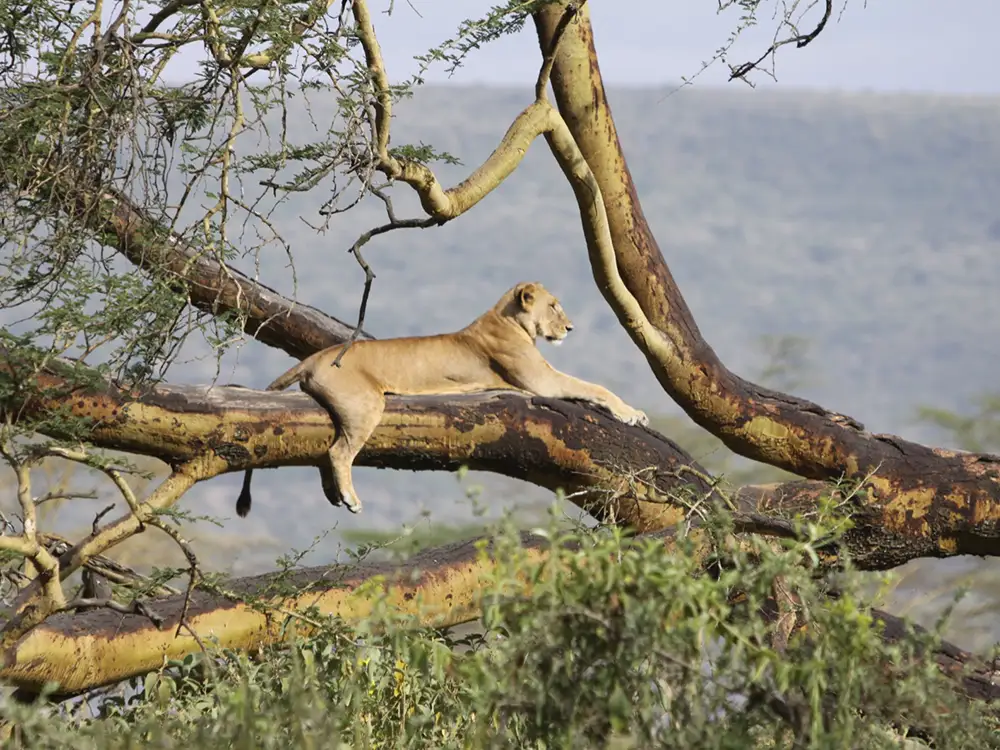
Much of the lake is surrounded by forests of the yellow-barked Acacia Xanthophlea, known as the yellow fever tree. These forests abound with bird life, and Naivasha is known as a world class birding destination. The waters of the lake also draw a great range of game to these shores. Giraffes wander among the acacia, buffalo wallow in the swamps, and Colobus monkeys call from the treetops while the lake's large hippo population sleep the day out in the shallows.

Maasai Mara National Game Reserve

The Maasai Mara is located about 270 kilometers west of Nairobi, and extends to the Serengeti ecosystem in Tanzania. Maasai Mara was established as a National Game Reserve in 1974 and covers an area of 1,510 sqare kilometers. The Maasai Mara is at an altitude of 1650 meters (5210 ft), and is crossed by two permanent rivers, the Mara and Talek.

All the commonly seen mammals of Kenya are found in the Reserve. The only exceptions are those that live in dry areas or are restricted to the northern parts of the country such as reticulated giraffe, gerenuk, grevy zebra, side striped jackals, and others. Maasai Mara hosts over 480 bird species. The most common species include: Secretary bird, Vultures, eagles, Guinea fowls, Ground hornbills, Bustards, Somali ostrich, Herons, Ibis, ducks, geese, plovers, sandgrouse, rollers, Kingfishers and many others.

The Maasai Mara is endowed with a great variety of nearly all plains game and offers a wide choice of food for the predatory lion, leopard, cheetah, hyena, wild-dog, jackals and thousands of the other lower carnivores. The Mara River, which is frequently flooded during the rains, houses schools of hippo and large colonies of crocodile. The Mara's major attraction is the world famous and most spectacular annual migration of nearly two million wildebeest and zebras from Serengeti National Park in Tanzania to the reserve (July to September) and back to Serengeti in January and February.

The herds turn northwards before reaching Lake Victoria and cross the Mara River into Kenya, looking for green pastures in the Maasai Mara. When the herd leaders smell the short rains of October, they command their herds southeastwards across Olduvai Gorge back to Serengeti. It was in the Olduvai Gorge where Dr. Louis Leakey discovered the remains of early man and some bones of wildebeest all dating back to two million years, thus proving that the Serengeti-Mara wildebeest migration has existed for millions of years.

During the annual migration, these animals are followed by hyenas, lions, wild dogs and vultures. Safari visitors to Mara in August through September will certainly see the splendor of this natural phenomena happening as it was hundreds of years ago. Apart from the migratory animals Maasai Mara is rich in resident game with over 95 species recorded in the Reserve.


For more information, visit these links:

Kenya Tourist Board -- Official Website

Kenya Wildlife Service

Useful Swahili

[ Dates & Fees ]


We typically do this trip for pre-existing groups. Please contact us if you are interested in a group trip to this destination.

info@wildernessinquiry.org
612-676-9400
800-728-0719

(Join our waiting list to be notified when WI schedules a trip to Mt. Kenya Climb)

Printer Friendly Page
printer friendly
Quick Trip Facts:
  • 7 days (6 on mountain), 7 nights
  • Experienced local guides and cook
  • Transportation to and from trailhead
  • Park and camping fees included
  • All group gear including tents, stoves, cook gear, etc. is provided
  • All meals and snacks on the mountain
  • Accommodations in Nairobi hotels on first and last night
  • Chance to summit a 16,355 ft. peak!


Maasai elder drinking honey beer from a gourd on Kenya Safari.